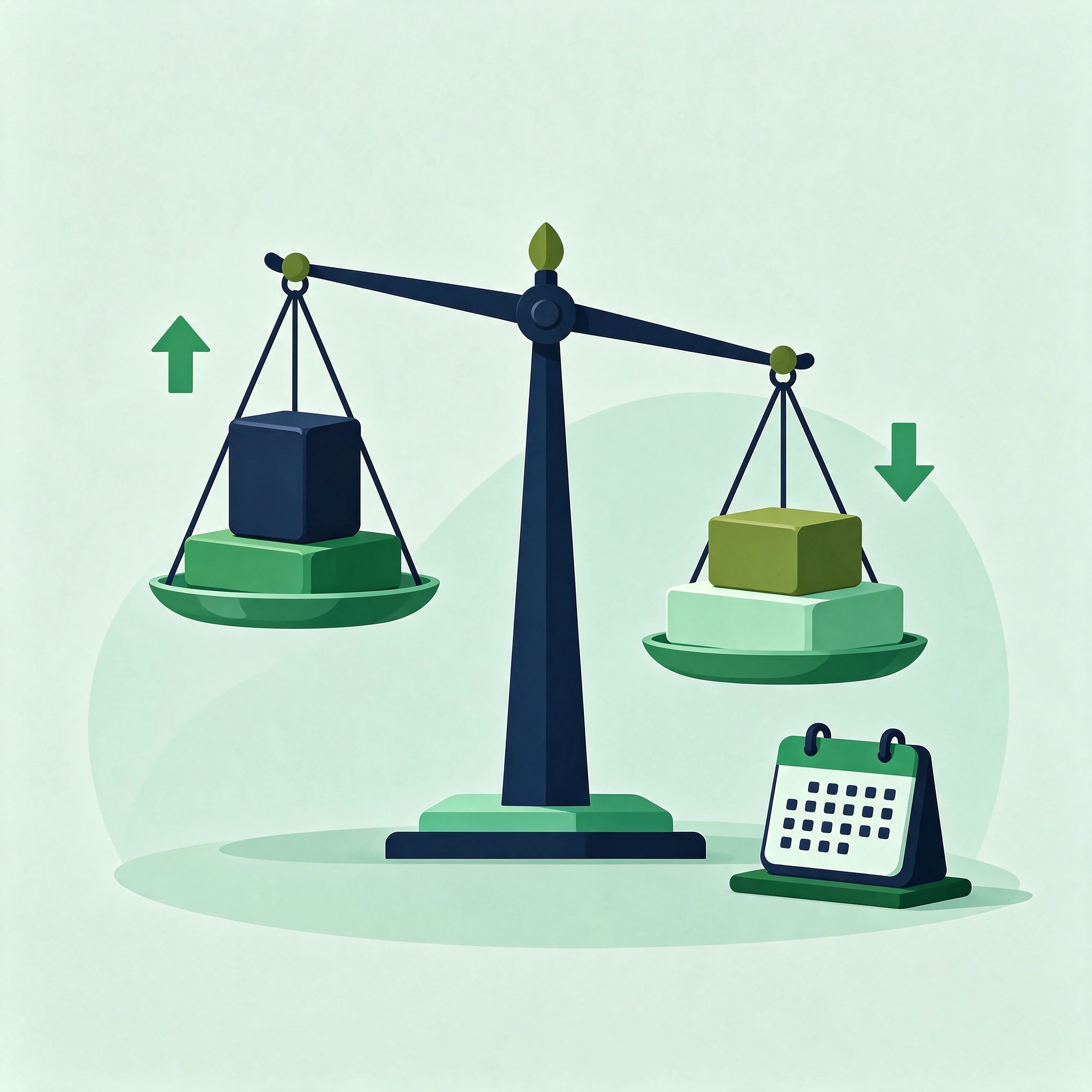
How a grid bot works
You choose a lower price, an upper price and a number of grid levels. The bot places buy orders below the current price and sell orders above it. When price drops to a buy level, the order fills and the bot places a sell order one step higher. When that sells, it buys again one step lower. Each completed pair earns the difference between the two prices, minus fees.
Simplified example: the range is 90 to 110 and the step is 2. The bot buys at 98 and sells at 100, then buys at 98 again if price returns. Each round trip earns about 2 per unit, before fees.
Where a grid bot works
- Price moves up and down inside the range.
- Swings are larger than the cost of a round trip, which is two fees plus any spread.
- You can leave it running without watching every move.
Where it hurts
- Price falls below the range. The bot has been buying all the way down, so you hold the coin at an average price above the market and no further orders work until price returns.
- Price rises above the range. The bot has sold along the way, so you hold mostly the quote currency and miss the rest of the rally.
- Steps too small. If the step is close to the fees, there is no profit. With a 0.1% fee on each side, a round trip costs about 0.2%, so the step must be clearly larger than that.
- Leverage. Futures grids add liquidation risk (see Bybit Liquidation: How It Works and How to Avoid It).
What manual trading offers
Manual trading lets you react to news, change your plan and skip trades that do not look right. It costs time and attention, and it exposes you to emotional decisions. It also does not run at night unless you place orders in advance.
Comparison
- Time. Bot: set up once, then check now and then. Manual: continuous attention.
- Best market. Bot: sideways and choppy. Manual: any, if you have an edge.
- Discipline. Bot: follows the rules every time. Manual: depends on you.
- Fees. Bot: many small trades, so fees matter more. Manual: depends on how often you trade.
- Control. Bot: limited to the settings. Manual: full control.
If you try a grid bot
- Start with a small amount you can afford to leave in a losing position for a long time.
- Choose a range from where price actually traded over recent weeks, not from hope.
- Check that the step is larger than your round trip cost (see How to Estimate the Total Cost of a Trade Before You Open It).
- Decide in advance what you will do if price leaves the range.
- If a bot connects to your account through an API key, give it only the permissions it needs (see API Key Safety for Traders and Trading Bots).
Bot features and menus differ between exchanges, so read the exchange's own guide first, for example in the Bybit Help Center. Because a bot trades often, the fee rate is important, and accounts registered through our referral link return part of the trading fees as cashback.
This article is educational and is not investment advice. Crypto assets carry a high risk of loss.
Get part of your trading fees back
Open the Telegram bot, link your exchange account and follow your cashback balance.